



Products Details

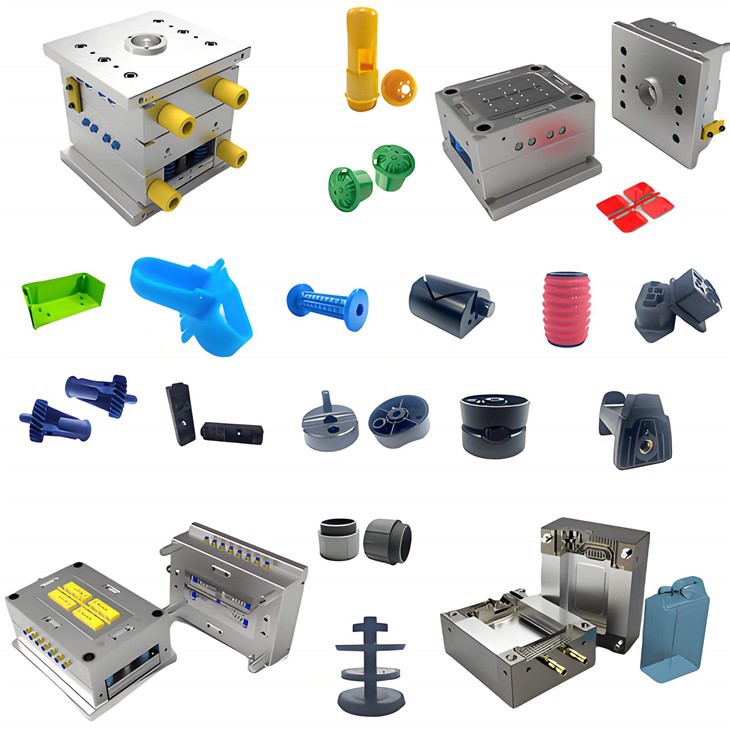
Starway mold plastic Injection is the most critical step in the production of injection-molded products. Any relevant injection molded products have to have a specific mold to specifically realize it. It is the key equipment in the injection molding process. High-quality mold plastic Injection have a direct impact on product quality, production efficiency, and cost.
The advantages of plastic injection in molds are fourfold:
High-precision molding:
Capable of producing parts with complex shapes and high dimensional accuracy.
High production efficiency:
Suitable for mass production with low unit cost.
Design Flexibility:
Molds can be customized to adapt to different specifications, materials, and functional requirements.
Multiple material support:
Can be used to produce a wide range of thermoplastics, such as ABS, PP, PE, etc.
Top 5 Common Prototype Injection Molding
Some of the advantages, disadvantages and features of the molds are described in detail below.
aluminum mold
Characteristics of Aluminum Molds:
Lightweight
The lower density of aluminum alloy makes the mold lightweight and easy to process, transport, and assemble.
It reduces the need for injection molding machine tonnage and lowers the cost of using processing equipment.
High thermal conductivity
Aluminum alloys have excellent thermal conductivity, which significantly reduces cooling time and improves injection molding productivity.
This is particularly advantageous for rapid molding and short-cycle production.
Easy Machinability
Aluminum is a softer material, making it easier for CNC machining, cutting, drilling, and other operations.
The production cycle is short, usually only 3-10 days to complete the mold.
Cost Advantage
Production costs are lower than steel molds, making it suitable for small-batch production projects with limited budgets.
Complex heat treatment and hardening processes are not required, further reducing production costs.
Good surface finish
The surface of aluminum is easy to be polished, sandblasted, anodized, etc., which can meet certain appearance requirements.
Advantages of Aluminum Molds:
Short production cycle
From design to delivery, aluminum molds typically take only 3 days to 2 weeks, which is faster than traditional steel molds.
Affordable
Suitable for small batch or ad-hoc production needs, it can significantly reduce initial development costs.
Flexible
The mold structure can be easily adjusted, which is suitable for a rapid iterative product development process.
Suitable for a wide range of products
Complex shapes or thin-walled parts can be produced to meet diversified product design requirements.
Easy maintenance
Aluminum mold surface treatment is simple, with a low maintenance cost.
Disadvantages of Aluminum Molds:
Short service life
Aluminum alloy has low hardness and abrasion resistance. Usually can only withstand 500-10,000 injections, which cannot meet the demand of mass production.
Poor heat resistance
Aluminum has limited ability to withstand high temperatures, and prolonged high-temperature injection may lead to mold deformation.
Insufficient strength
For products that require high strength or ultra-high pressure injection (e.g. glass fiber reinforced plastics), aluminum molds may not be suitable.
Limited precision
Although aluminum molds can achieve higher precision, the tolerance control ability is still slightly inferior compared to high-end steel molds.
Scenarios for Aluminum Molds:
Prototype development
Verify the feasibility of the design and quickly generate samples for testing.
Small batch production
Meet the production demand of tens to thousands of pieces, suitable for trial production and market testing stage.
Product Verification
Produce samples close to mass production for functional verification or appearance demonstration.
Short lead time projects
Apply to production tasks with tight delivery times to support quick turnaround.
flexible steel mold
Characteristics of Soft Steel Molds:
Moderate strength
The material hardness is usually between 28-32 HRC, which can meet the needs of medium-volume injection molding (5,000 to 50,000 cycles).
Easier to work with than hard steel molds, able to withstand a certain level of strength and pressure.
Better abrasion resistance
Soft steel has better wear resistance than aluminum molds, making it suitable for longer cycle times.
Moderate cost
Lower cost compared to hard steel molds, but significantly higher strength and service life than aluminum molds, suitable for medium production projects with limited budgets.
Easy to modify
The high toughness of the material allows the mold to be easily processed and adjusted after the mold trial, supporting design optimization.
Versatility
Can be used to make complex structures or multi-cavity molds to meet a wide range of product needs.
Advantages of Flexible Steel Molds:
Longer life
Typically supports tens of thousands of injection cycles, making it suitable for medium-volume production needs.
Moderate cycle time
The processing speed is faster than that of hard steel molds. But slightly slower than that of aluminum molds, with a general production cycle of about 2-4 weeks.
Cost-effective
The balance between strength, life, and cost. It is especially suitable for function testing, trial production, and some mass production projects.
Suitable for a wide range of plastics
Adaptable to injection molding of most engineering plastics, including ABS, PC, PP, etc.
Higher precision
Compared with aluminum molds, flexible steel molds can achieve higher dimensional accuracy and surface finish.
Disadvantages of Soft Steel Molds:
Limited hardness
Weak for ultra-high-pressure force injection molding or processing of glass-fiber-reinforced materials
Poor corrosion resistance
Prone to rust in high humidity or acidic environments, requiring regular maintenance and the application of rust inhibitors.
Heavyweight
Heavier than aluminum molds, resulting in higher transportation and assembly costs.
Longevity is not as good as hard steel molds
Cannot support long-term mass production needs. Not suitable for projects with more than one million cycles.
Common Materials for Soft Steel Molds
P20 steel
Commonly used low hardness mold steel, hardness in 28-32 HRC, suitable for medium volume production.
Good workability, moderate wear resistance, cost-effective.
718 steel
Chromium-containing mold steel has good wear resistance and corrosion resistance.
Commonly used in demanding injection molds, such as transparent parts, and precision parts.
S50C steel
A carbon tool steel that is inexpensive but less durable.
Suitable for short-term use or low-budget projects.
NAK80 Steel
Highly polished steel is suitable for products requiring a high surface finish, such as cosmetic housings.
Comparison of Soft Steel Molds with Other Molds
| Characterization | Soft Steel Molds | Aluminum Molds | Hard Steel Molds |
| Hardness | Moderate | Lower | High |
| Costs | Moderate | Lower | High |
| Cycle time | 2-4 weeks | 3-10 days | 4-6 weeks |
| Applicable Batches | 5,000-50,000 | 500-10,000 | 50,000 or more |
| Durability | Moderate | Relatively low | Relatively high |
| Modify the Difficulty | Easy to modify | Very easy to modify | Harder to modify |
3D Printing Molds
Features of 3D Printed Molds:
High flexibility
Complex geometric shapes can be printed with a high degree of design freedom, enabling the realization of structures that are difficult to manufacture by traditional processing methods, such as internal cooling channels and lightweight design.
Short production cycle
Usually, 1-3 days to complete the mold manufacturing, compared with the traditional mold to save a lot of time.
Low cost
Especially suitable for small batches or one-time production, avoiding the high upfront investment of traditional molds.
Material Diversity
Plastic, photosensitive resin, metal powder, and other materials can be used to adjust the performance of the mold according to the demand.
Suitable for verification design
Prototype molds can be made quickly for product design verification or small-lot trial production.
Advantages of 3D Printed Molds:
Rapid Manufacturing
From design to molding in hours to days, suitable for rapid iteration and validation.
Low Cost
Eliminates the need for expensive traditional mold steel and machining equipment, making it particularly suitable for low-volume production and experimental projects.
Complex Structure Manufacturing
Easy implementation of internal structures, shaped surfaces, and functional optimization such as hydrodynamic cooling channels.
Reduced material waste
Additive manufacturing uses only the materials needed and is more environmentally friendly than traditional cutting processes.
Design optimization support
Flexibility to modify mold designs as needed during production to quickly adapt to changes in demand.
Disadvantages of 3D Printed Molds:
Shorter lifespan
Compared with traditional steel molds, 3D-printed molds are less durable and are not suitable for prolonged use under high pressure and high temperatures.
Limited load-bearing capacity
Especially molds made of plastic or resin are easy to be deformed or damaged in the process of injection or die-casting.
Limited precision and surface quality
The texture of the printed layer may require additional processing, and the surface finish is not as good as traditional molds.
Material limitations
Although metal 3D printing technology is available, the cost is high, and common resin or plastic molds are limited in their applicability.
Insufficient batch capacity
Suitable for small batch trial production or validation, but not suitable for long-term mass production.
Material Selection for 3D Printing Molds:
Photosensitive resin
Suitable for small batch injection molding test or verification, with better molding accuracy and detail performance.
Plastic (e.g. PLA, ABS)
Molds printed using FDM technology, low cost, but lower heat resistance and strength.
Metals
Molds printed using metal powder (e.g. stainless steel, aluminum alloy) are suitable for high strength and high precision needs, with higher cost.
Composite Materials
Printing molds through reinforced plastic or composite materials for enhanced durability and functionality.
Comparison of 3D Printed Molds and Traditional Molds:
| Characterization | 3D Printing Molds | Traditional Moulds |
| Manufacturing Cycle | 1-3 days | 2-6 weeks |
| Costs | Down to medium | Middle to high |
| Applicable lot size | Small quantities (<1000 pieces) | Large quantities (>5000 pieces) |
| Manufacturing Flexibility | High | Low |
| Service Life | Short | Long |
| Complex Structure | Easy realization | Hard realization |
Silicone Mold
Features of Silicone Molds:
High flexibility and malleability
Silicone material has good flexibility and ductility. And can accurately replicate the details of the surface of the mother mold, suitable for complex geometric shapes.
High temperature resistance and chemical stability
High-quality silicone molds are typically resistant to high temperatures (-60°C to 250°C) and are resistant to most chemicals.
Low cost
Low production costs make them particularly suitable for small-lot production and rapid prototyping.
Short production cycle
The production process is simple, usually 1-3 days to complete the mold production and put it into use.
Wide range of applications
Can be used for molding a wide range of materials, including resins, polyurethane, wax, low melting point metals, etc.
Advantages of Silicone Molds
Simple manufacturing
Simple manufacturing process, no need for complex equipment or processes.
Low-cost adaptability
Ideal for small batch production or rapid prototyping, with significant savings in development costs.
High Reproduction Accuracy
Can accurately reproduce the details of the master mold, including minute textures and complex structures.
Flexible
Easy to release the mold, avoiding damage to the finished product.
Wide choice of materials
Can be used for molding a wide range of materials such as resin, polyurethane, gypsum, and low melting point metals.
Disadvantages of Silicone Molds:
Short service life
Compared with metal molds, silicone molds have a shorter wear resistance and life span. And generally can only produce dozens to hundreds of products.
Limited mechanical properties
Silicone molds have low hardness and strength, making it difficult to withstand high-pressure or high-temperature injection molding.
Insufficient dimensional stability
Silicone molds are prone to deformation due to repeated use, affecting the dimensional accuracy of products.
Sensitive to the environment
Silicone materials are susceptible to humidity and temperature and need to be stored under suitable conditions.
Silicone Mold Material Selection:
Transparent Silicone
For high precision molds and visual mold applications.
High Hardness Silicone
Provides better abrasion resistance and dimensional stability, and is suitable for small-batch production.
Food Grade Silicone
Used for food mold making, such as chocolate and cake molds.
Industrial Silicone
Suitable for industrial parts production, such as automobile parts, seals, etc.
Epoxy resin mold
Characteristics of Epoxy Resin Molds:
High strength and wear resistance
The epoxy resin hardens to form a hard surface that can withstand high mechanical stress, suitable for complex processes and long-time use.
Good chemical resistance
Resistant to acid, alkali, and most chemical solvents, especially suitable for resin impregnation molding of composite materials.
Excellent thermal stability
Epoxy resin molds can withstand high temperatures (usually 120°C-180°C, special epoxy can withstand up to 250°C), suitable for the hot press molding process.
High dimensional accuracy
Low curing shrinkage (usually less than 1%) maintains the detail and shape accuracy of the master mold.
High surface smoothness
The surface of the mold can be polished to a mirror effect, which helps to improve the quality of the finished product and the release effect.
Advantages of Epoxy Resin Molds:
Relatively low manufacturing cost
Lower cost than metal molds, suitable for small lot production and prototyping.
Lightweight
Compared to metal molds, epoxy resin molds are lighter in weight, making them easier to handle and manipulate.
High corrosion resistance
Resistant to a wide range of chemical solvents and materials, extending the life of the mold.
High processing flexibility
Mold properties can be adjusted with fillers or other reinforcing materials to meet a wide range of process needs.
Rapid molding capability
Short production cycle, suitable for rapid response to market demand.
Disadvantages of Epoxy Resin Molds:
Limited durability
Compared with metal molds, epoxy resin molds are less resistant to impact and abrasion. And are suitable for small and medium-sized mass production.
Lower thermal conductivity
Thermal conductivity is lower than metal molds, which may reduce productivity in certain heating processes.
High demolding requirements
It is easy to damage the surface of the mold when demolding, so it is necessary to use a high-quality mold release agent.
Easy to deform in large size
Large-size molds may be deformed under stress or a high-temperature environment.
Care and Maintenance of Epoxy Resin Molds:
Clean the surface
Clean the surface of the mold after each use to avoid residue damage to the mold.
Regular Inspection
Inspect the mold regularly for cracks, deformation, or wear.
Use of mold release agent
Apply the release agent evenly before each use to reduce damage to the mold surface.
Storage environment
Store the mold in a dry and cool place, avoid direct sunlight or a high-temperature environment.
Repair and Renovation
If the mold is damaged, it can be repaired with epoxy resin material to prolong the service life of the mold.
Comparison table of the number of times the mold is used
Comparison table of the number of times the Prototype mold is used
| Mould Type | Manufacturing Cycle | Number of Times Used | Applicable Scenarios |
| Aluminum Mold | 5-15 days | About 500-1000 times | Suitable for small batch production or prototype development, less frequent use, suitable for rapid prototyping. |
| Flexible Steel Mold | 10-30 days | About 5000-10000 times | Suitable for small and medium-sized batch production, longer service life, suitable for mass production with medium precision requirements. |
| Silicone Mold | 2-7 days | About 10-50 times | Suitable for rapid prototyping, small batch production or artwork, etc. Limited use, easily damaged, suitable for parts with complex shapes. |
| 3D Printing Molds | 1-7days | About 10-100 times | Suitable for low volume production, prototyping or complex shaped parts, but poor durability and not suitable for long term use. |
| Epoxy resin mold | 5-10days | About 100-500 times | Applicable to small and medium-sized mass production, higher precision, relatively more frequent use, but still less durable than metal molds. |
How to Choose the Best Suitable Injection Mold?
Sample Quantity

Product Requirements

Time cost
Budget constraints
It should be noted that the selection of all injection molding prototypes should first refer to the product's own requirements and price, the combination of the two in order to select the most suitable prototype molds
Mold plastic injection manufacturing process
The following six points are necessary processes when manufacturing molds
Customer Demand Analysis: Before manufacturing mold plastic injection, you first need to communicate with the customer to understand the specific requirements of the product, such as appearance, function, material, strength, size, etc... At this time, it is also necessary to consider the design for manufacturability (DFM) of the injection molded product to ensure that the design can be smoothly processed and manufactured by the mold.
Mold Flow Analysis: Mold flow analysis is a computer simulation of the injection molding process to predict the path of plastic melt flow, temperature distribution, pressure changes, and other information. It helps to identify potential problems such as bubbles, short shots, uneven cooling, etc., and then optimize the mold plastic injection design.
3D Design: Mold engineers use professional CAD software (e.g. SolidWorks, CATIA, UG, etc.) to draw the 3D design of the mold. The design process includes the structural design of the mold plastic injection, the design of the mold cavity, the design of the cooling system, the design of the gates and runners, the design of the ejection system, and so on. The goal of the design is to ensure the efficient operation and long-term stability of the mold plastic injection.
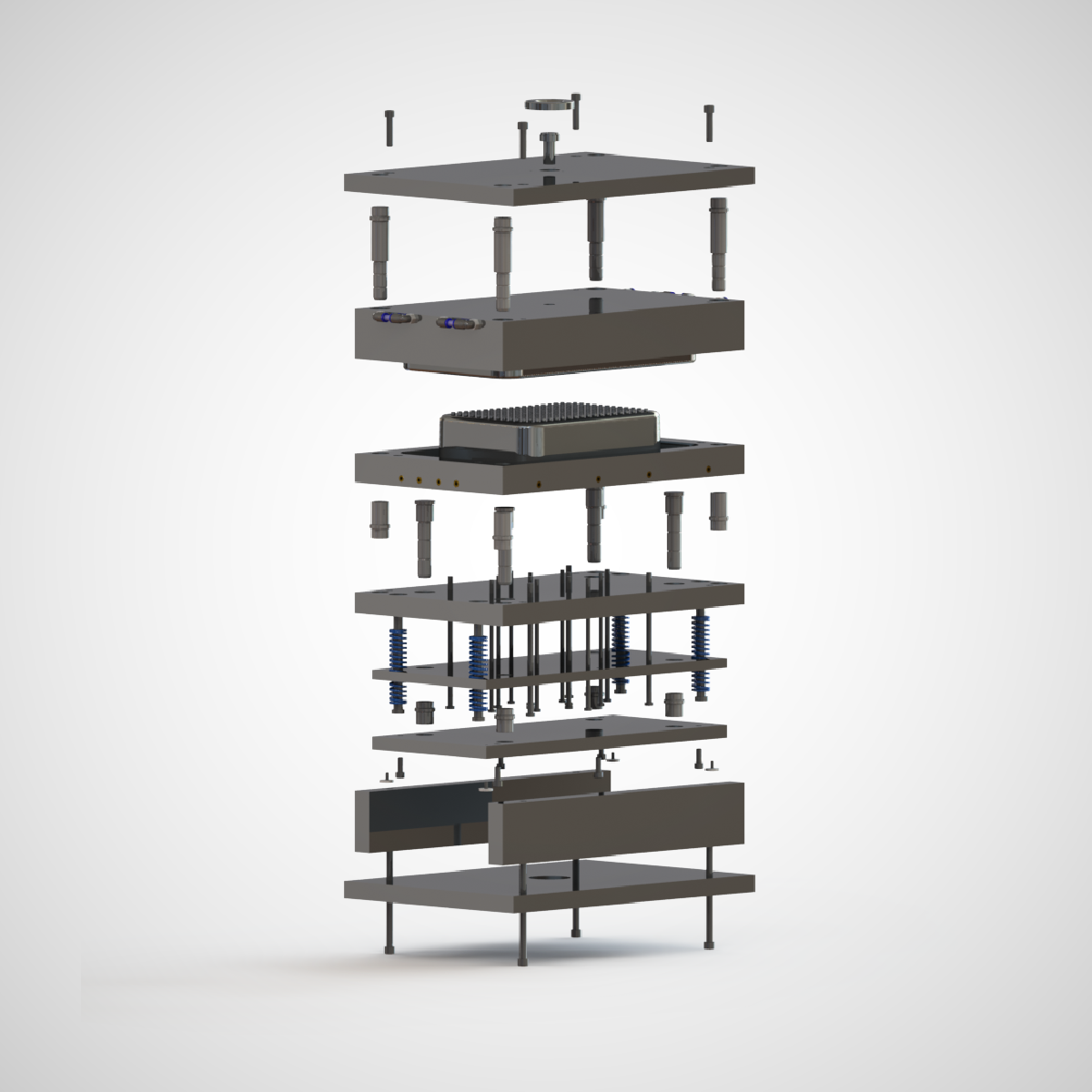
Structural Design of Mold: The basic structure of mold plastic injection includes fixed mold, moving mold, pouring system, cooling system, ejector system, and so on. The design of each part needs to be precisely coordinated to ensure that the mold can work smoothly.
Cavity Design: According to the shape, size, and complexity of the plastic products, the mold cavities of the mold are designed, and the number of cavities can be a single-cavity mold or a multi-cavity mold. Multi-cavity molds are usually used for mass production to increase efficiency.
Cooling System Design: Cooling system design directly affects the molding cycle and product quality. A well-designed cooling system can cool the plastic quickly, shorten the cycle time, and avoid warping and deformation of the product.
Injection Molding Machine Selection: According to the size, weight, and injection pressure of the mold, select the appropriate injection molding machine.
All of these tasks are to be clear before the mold production needs to be designed. Good mold is needed from the customer demand to the production accuracy of each mold part to consider together!
Material selection:
Steel Mold: Usually use higher hardness steel, such as P20, H13, S136, etc. It is suitable for mass production and has a long service life.
Aluminum Mold: Aluminum molds are lightweight, have short processing cycles, and are suitable for small batch or rapid prototype production.
Soft Steel Mold: used for low to medium-volume production, with good cost-effectiveness.
Plastic Molds: suitable for some simple molding needs, and usually applied to low-cost product production.
Machining process:
Rough Machining: First, CNC machining centers and CNC lathes are used for rough machining to remove excess material and form the general shape of the mold.
Finishing: Next, the mold is finished using high-precision equipment to ensure dimensional accuracy and surface finish. For finishing, complex detail parts can be machined using Electric Discharge Machining (EDM) equipment.
Cooling System Machining: Cooling holes and runners are precisely machined by CNC drilling machines to ensure optimal cooling.
Polishing and Plating: Polishing is performed on the mold surface to ensure that the surface of the final product is smooth and free from scratches and imperfections. Meanwhile, to enhance the durability of the mold, treatments such as chrome plating or nitriding can be added to the mold surface.
Assembly: Assemble each processed part into a complete mold to ensure that each part is well coordinated and moves smoothly.
Debugging: After installing the mold on the injection molding machine, carry out a trial mold. Check the quality of the molded products during the trial molding process, including the appearance, size, molding defects, and so on. At the same time, fine-tuning is carried out as needed, such as modifying the gate design and optimizing the cooling system.
Functional Test: To ensure that the mold can work properly, the ejector system, cooling system, and pouring system must all operate effectively.
This step is to ensure that the subsequent production of product quality is out of the necessary prerequisites, only to do a good job in all aspects of the debugging of the subsequent production of products to achieve the desired results!
Dimension Check: Dimension measurement is carried out by precision measuring tools such as the Coordinate Measuring Machine (CMM) to ensure the precision of mold processing.
Trial mold inspection: Conduct actual trial molds to check whether the produced plastic parts meet the design requirements and whether there are bubbles, flaws, or shape defects.
Product Consistency: Conduct verification before mass production to ensure product consistency during mass production.
This step is the acceptance that will directly determine the subsequent mold production of products, but also the most important step!
Regular Maintenance: Clean and inspect the molds regularly. And repair any worn or damaged parts in time to prolong the service life of the molds.
Lubrication and Anticorrosion: Regularly fill the mold with lubricant to prevent rust and corrosion, especially on the used cooling holes and moving parts.
This step of the process is to extend the service life of the mold plastic injection, making the cost of individual products lower.
From demand analysis, mold design, and processing to final assembly and debugging, each step determines the quality of the mold and the final product. By continuously optimizing the design and choosing the right material for the mold plastic injection, manufacturers can provide high-quality mold plastic injection to meet customers' production needs and ensure efficient production of products.
Product Requirements
1.Product size, shape, and functional requirements.
2.Surface quality requirements (e.g. gloss, texture).
Material selection
Properties of plastic materials such as fluidity, shrinkage, and high-temperature resistance.
Mold life
1.Wear resistance and hardness of the mold material (e.g. P20, H13 steel, etc.).
2.Surface treatment process (e.g. chrome plating, nitriding) to extend the service life.
Processing precision
Ensure precision fit between mold parts to avoid defects such as flying edges and warping of products.
Cooling efficiency
Cooling system design directly affects molding cycle time and production efficiency.
Production efficiency
Whether to use multi-cavity design, automated demolding, etc. to improve production speed.
Injection molding average service life reference
| Mold type Average | Aluminum mold |
| Ordinary steel mold | 500,000~1,000,000 die times |
| High quality steel mold | 1,000,000~2,000,000 die times and above |
| Aluminum mold | 10,000~100,000 die times |
More detailed data below
| Main Product | Plastic injection mold,Medical part mold,IML/IMD,2K injection mold,Silicone rubber mold,Die casting,Prototype,CNC Milling, CNC turning... |
| File Format | Solidworks,Pro/Engineer,Auto CAD,PDF,JPG,Sample |
| Plastic Material | HIPS ABS, PC, PP, PS, POM, PMMA,PE,AS,PPSN,PBT,PA66,PC/ABS.etc |
| Moulds' lead time | 20-35days,it depends on the product's size and structure |
| Bulk production lead time | 25-30days,it depends on the product's size and structure |
| Product's weight range | 1g to 5000g |
| Mould Precision | +/-0.01mm |
| Mould Life | 300k-500K shots,update moulds for free |
| Mould Cavity | Single cavity, multi-cavity. |
| Runner System | Hot runner and cold runner. |
| Equipment | 1.Tooling Development Machinery : Swiss Mikron High Efficiency Machining Center, Swiss Mikron High Speed CNC Machining Center,Japan Makino CNC Milling Machining Center,Taiwan Well Head CNC Machining Center,Swiss Charmilles EDM Machining Center,Japan Makino EDGE 3S Sinker EDM...2.Component Finishing Machinery: Henghui Sing & Bio-Padding Machine,100,000 Grade Oil Spraying Line... 3.Injection Machenery: TOYO Fully Electric Injection Molding Machine Si-Five,YIZUMI Injection Machine,DONGHUA Injection Machine,HAITIAN Machinery,SUMITOMO Injection Machine,HAITIAN Double Molding Machine... |
| Injection machies equipments | According to product precision to choice the different model 80T,120T,250T,450T,800T,1200T injection machine. |
| Surface Treatment | Polishing,Painting,Chroming,Anodizing, Brushing, Silk Screening,Water Transfering, Laser Cutting,Leather Covering,Texture, Sanblasting,Gilding, UV Painting… |
| Color | White, black, red, blue..et. according to customer's requirement. |
| Inspection | 100% inspection by QC, QA before shipping. |
| Applications | All kinds of cars spare part , machinery, home appliance, electronic products, medical devices, stationery, computers, power switches, miniature switches, architecture, commodity and A/V equipment, hardware and plastic molds, sports equipment and gifts,and more. |
| Quality Control System | ISO9001 quality management system certification. |
| Package | According to customer's requirement |
Our Services

Injection Molding Design & Engineering
1.Mold design with 4 engineers with 5-10 years of experience
2.3D Solid Modeling
3.Adaptation of process parameters
4.Mold flow analysis

Injection Molding Making
1.In-house mold processing and manufacturing ("We never outsource!")
2.100+ world-class precision machining facilities
3.Tolerances of ±0.001mm
4.ISO 9001 certified standards

Plastic Parts Production
1.20+ 35 tons - 1200 tons injection molding machines
2.Hundreds of thermoplastic materials to choose from
3.Strict quality control: IQC, IPQC, FQC
4.Customized packaging and packing after injection molding
Types of Injection Molding Molds:
-
Classified by the Number of Mold Cavities:
-
Single-cavity Mold: molding one product at a time, suitable for small batches or high-precision products.
-
Multi-cavity Mold: molding multiple products at a time, improves production efficiency, suitable for mass production.
-
-
Classified by mold structure:
-
Two Plate Mold: simple structure, suitable for general plastic products.
-
Three-platen Mold: increase the separation function of the pouring system, suitable for complex products or multi-point feeding.
-
-
Classified by application:
-
Hot Runner Mould: Reduce waste and improve molding efficiency by heating the runner system.
-
Cold Runner Molds: traditional molds, are lower cost, but produce more scrap.
-

Structure of injection molding molds:
-
The Main Components of the Mold:
Dynamic and Fixed Mold: The mold consists of a dynamic mold (mounted on the moving template of the injection molding machine) and a fixed mold (mounted on a fixed template), which are closed to form a mold cavity.-
Cavity and Core: The cavity determines the shape of the product and the core forms the internal structure of the product.
-
Pouring System: Includes main flow channels, manifolds, gates, and cold pockets, which are used to transport the plastic melt into the mold cavity.
-
Cooling System: helps the molten plastic to solidify and mold quickly through cooling waterways.
-
Exhaust System: exhausts air or melt gas from the mold cavity to avoid defects.
-
Demolding System: including ejector pins, push plates, etc., used to eject the molded product from the mold.
-
-
Auxiliary Structure:
-
Guide Pillar and Guide Bushings: ensure the alignment accuracy of the moving and fixed molds.
-
Mold Base: Fixes and supports the mold components, providing strength and stability.
-
Material Details Display Sheet
| Material | Recommended wall thickness [mm] | Recommended wall thickness [inches] |
| Polypropylene (PP) | 0.8 - 3.8 mm | 0.03'' - 0.15'' |
| ABS | 1.2 - 3.5 mm | 0.045'' - 0.14'' |
| Polyethylene (PE) | 0.8 - 3.0 mm | 0.03'' - 0.12'' |
| Polystyrene (PS) | 1.0 - 4.0 mm | 0.04'' - 0.155'' |
| Polyurethane (PUR) | 2.0 - 20.0 mm | 0.08'' - 0.785'' |
| Nylon (PA 6) | 0.8 - 3.0 mm | 0.03'' - 0.12'' |
| Polycarbonate (PC) | 1.0 - 4.0 mm | 0.04'' - 0.16'' |
| PC/ABS | 1.2 - 3.5 mm | 0.045'' - 0.14'' |
| POM (Delrin) | 0.8 - 3.0 mm | 0.03'' - 0.12'' |
| PEEK | 1.0 - 3.0 mm | 0.04'' - 0.12'' |
| Silicone | 1.0 - 10.0 mm | 0.04'' - 0.40'' |
Product Case Show


starway factory strength
Our free service hotline:+86 15821850866

13
years
We have been working in the industry since 2011
5
TEAMS
We have 5 teams which are a market development team, 4 processing workshops, a purchasing team, an engineering team, and a quality control team.
3
day prototype
We can prototype a product in as little as 3 days
If you are interested in our products or you wanna make and customize products, please feel free to contact us.
Hot Tags: mold plastic injection, China mold plastic injection manufacturers, suppliers, factory


