



Laser welding is much cleaner than conventional arc or Tig welding, and therefore helps risk of contamination. It's also more precise, easier to automate, and provides for bonding of much thinner metals, and provides for much greater tensile and bending strength.
Unlike arc welding, which requires a bonding material or filler to join two pieces of metal, laser welding creates a straight metal-to-metal bond with no filler needed. It is easy to automate with high repeatability.
There are several key factors that affect weld quality and speed of laser welding. Those factors include the width of the weld spot, the depth of penetration of the weld into the metal, the intensity of the heating, and the path and speed of the beam along the metal surface. With precise control, welding can be easily automated and that there is less variability in the weld, higher quality and faster overall production.
However, like any production process, of course, laser welding does have its limitations. It's not suitable for welding thick heavy pieces.
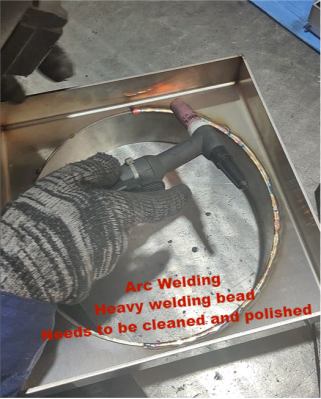
The following is an example of how we negotiate with customers to choose laser welding or argon arc welding:

We will be happy to consult with you on which welding approach is best and the advantages and drawbacks of each. Please contact us for metal fabrication!