



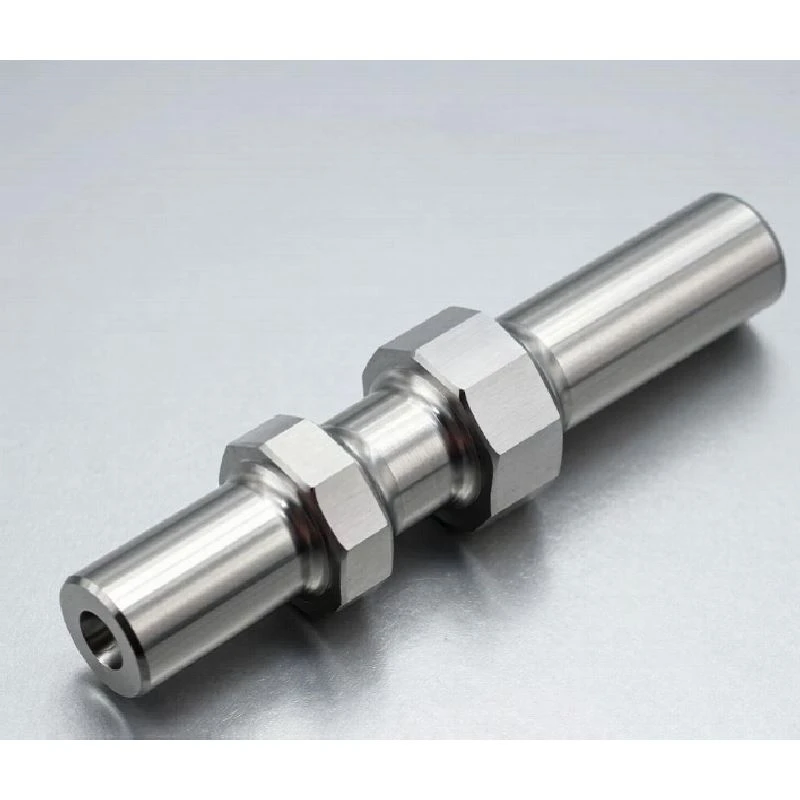
Precision Stainless Steel CNC Turned Shafts
Custom stainless steel CNC turned shafts manufactured from engineering drawings, 3D CAD files, or approved samples for applications requiring controlled diameters, accurate fits, stable rotation, and repeatable assembly.
Precision Shaft Manufacturing Focused on Functional Features
Precision outside diameters, stepped profiles, tapered sections, chamfers, and radii.
Bearing and bushing journals, locating shoulders, retaining ring grooves, and relief grooves.
Metric, UNC, UNF, NPT, and BSP threads.
Axial and cross-drilled holes, milled flats, and keyways.
Material Selection Guide
|
Stainless Steel Grade |
Key Material Characteristics |
Primary Application Scenarios |
|
303 Stainless Steel |
Superior machinability; ideal for intricate turned details, tight tolerances, and threads. |
Fasteners, precision turned components, general shafting. |
|
304 Stainless Steel |
General-purpose option with strong corrosion resistance and balanced strength. |
Industrial machinery, processing equipment, standard structural shafts. |
|
316 / 316L Stainless Steel |
Added molybdenum for exceptional resistance to chlorides, moisture, and chemicals. |
Marine environments, chemical processing, medical, and pump shafts. |
|
17-4 PH Stainless Steel |
High strength and hardness achievable through heat treatment (e.g., H900, H1150). |
High-load drive shafts, aerospace components, heavy machinery. |
Manufacturing & Technical Specifications
|
Parameter Category |
Technical Capability & Range |
|
Accepted File Formats |
STEP (.step, .stp), IGES (.igs), SolidWorks (.sldprt), DXF, DWG, PDF |
|
Dimensional Control |
Diameter tolerances, overall length, step length according to functional drawings |
|
Geometric Tolerances |
Circular/Total Runout, Concentricity, Roundness, Straightness |
|
Surface Finish Capabilities |
As-machined, precision centerless grinding, surface grinding, polishing (Ra values as specified) |
|
Secondary Operations |
CNC milling, cross-drilling, keyway slotting, heat treatment, passivation, electro-polishing |
|
Quality Management |
Manufactured under ISO 9001:2015 certified processes |
|
Inspection & Documentation |
CMM, optical comparators, thread/bore gauges, Material Test Reports (MTR per EN 10204 3.1) |
|
Production Volumes |
Fast-turn Prototypes, Pilot Batches, High-Volume OEM Production |
Solutions to Common OEM & Assembly Issues
Eliminating Bearing Fit Failures: Bearing seats are machined to specified tolerances (press, transition, or clearance fits) and controlled surface finishes to ensure smooth assembly without bind or slop.
Preventing Vibration & Seal Wear: Rigorous total runout and concentricity controls prevent rotational vibration, uneven component wear, and premature seal failures.
Ensuring Batch-to-Batch Repeatability: Locked-in drawing revisions, machining paths, and inspection protocols guarantee that high-volume repeat orders match the dimensions of approved prototypes.
Single-Source Manufacturing: Consolidating CNC turning, milling, grinding, heat treatment, and surface finishing under one roof reduces lead times, multi-vendor management, and transport risks.
FAQ
Q: What stainless steel grades are commonly used for CNC turned shafts?
A: Common options include 303, 304, 316, 316L, and 17-4 PH stainless steel. The appropriate grade depends on the required machinability, corrosion resistance, mechanical strength, operating environment, and surface requirements.
Q: Can stainless steel shafts be manufactured according to custom drawings?
A: Yes. Custom shafts can be manufactured from 2D engineering drawings, 3D CAD files, PDF drawings, technical specifications, or approved samples. Critical dimensions, fits, threads, grooves, surface finish, and inspection requirements should be clearly identified.
Q: What tolerance can be achieved on a stainless steel CNC turned shaft?
A: The achievable tolerance depends on the material, shaft geometry, diameter, length, machining process, and inspection requirements. Functional dimensions should be specified individually rather than applying one unnecessarily tight tolerance to the entire shaft.
Q: Can concentricity and runout be controlled?
A: Concentricity and runout can be addressed when they are defined as functional requirements on the drawing. These parameters are particularly important for shafts used with bearings, gears, couplings, seals, and other rotating components.
Q: Can CNC turned shafts include threads, grooves and keyways?
A: Yes. CNC turning can produce diameters, shoulders, grooves, chamfers, and external or internal threads. Milling and drilling operations can be added for keyways, flats, cross holes, and other non-rotational features.
Q: What surface finish is suitable for a bearing shaft?
A: The required surface finish depends on the bearing type, shaft fit, operating speed, lubrication, sealing arrangement, and application. The required surface roughness should be specified on the engineering drawing when it is a functional requirement.
Q: How should I select between 303, 304 and 316L stainless steel?
A: 303 is often considered when machinability is important. 304 is a common general-purpose stainless steel option. 316L is considered when greater corrosion resistance is required.
Q: What information should I provide for a CNC shaft quotation?
A: Provide the engineering drawing or CAD file, stainless steel grade, quantity, shaft dimensions, critical tolerances, bearing or bushing fit, threads, grooves, surface finish, heat treatment or surface treatment requirements, inspection requirements, and target delivery schedule.
Hot Tags: precision stainless steel cnc turned shaft, China precision stainless steel cnc turned shaft manufacturers, suppliers, factory, Stainless CNC Turning Ring


