



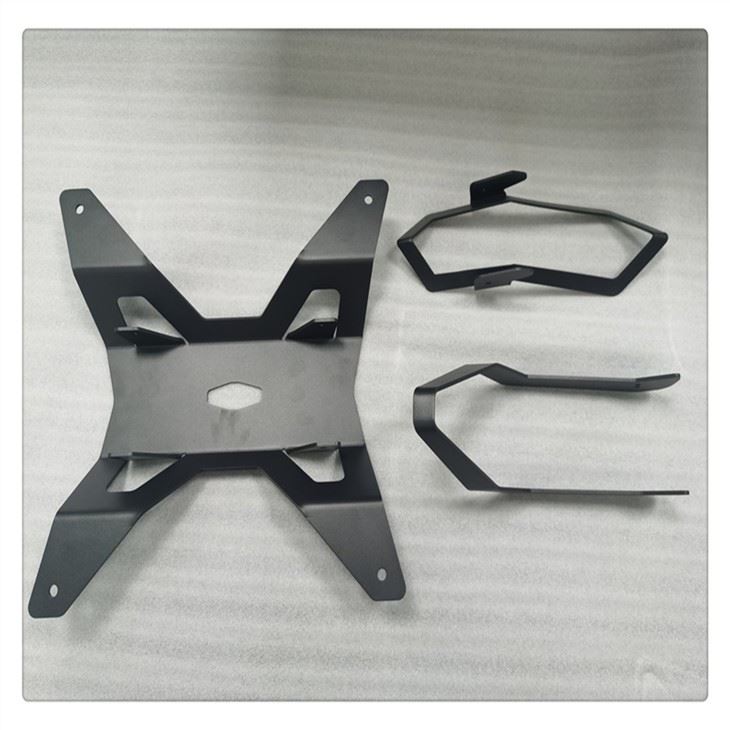
Custom Automotive Metal Mounting Brackets
Custom automotive metal mounting brackets are designed to position, support, secure, and reinforce components within vehicle assemblies. Because bracket geometry is defined by surrounding components, mounting hole positions, bend angles, sheet thickness, clearances, and mounting surface locations must all work together accurately.
Key Design Features
Mounting Holes and Slots: Laser-cut or precision-punched for exact fastener alignment.
Multiple Bends and Offsets: Designed to fit compact installation spaces around wiring, connectors, and body panels.
Structural Reinforcements: Formed flanges, stiffening ribs, and folded tabs that increase structural rigidity without adding excessive sheet thickness.
Secondary Features: Countersunk holes, threaded inserts, tapped holes, component clearance cutouts, and welding/riveting points.
Materials and Surface Treatments
|
Category |
Material / Finish Grade |
Key Characteristics |
Typical Automotive Applications |
|
Carbon Steel |
SPCC, SPHC, Q235, Q355 |
High strength, cost-effective, good formability |
Heavy-duty supports, chassis and body brackets |
|
Stainless Steel |
SUS304, SUS316, SUS430 |
High strength, superior natural corrosion resistance |
Exposed underbody components, engine bay brackets |
|
Aluminum |
AL5052, AL6061-T6 |
High strength-to-weight ratio, lightweight |
EV battery module supports, electrical enclosures |
|
Surface Finish |
Zinc Plating (Cr3+) |
Basic corrosion protection, economic |
Interior structural brackets |
|
Surface Finish |
E-Coating (Electrophoretic) |
High salt-spray resistance, uniform coverage |
Chassis and underbody components |
|
Surface Finish |
Powder Coating |
Durable impact resistance, aesthetic finish |
Exterior and engine compartment brackets |
Quality Assurance and Compliance
System Compliance: Manufactured under quality management procedures compliant with ISO 9001 and IATF 16949 standards.
Critical Dimensional Verification: Inspection focuses on hole-to-hole distance, hole-to-bend alignment, bend angles, mounting surface flatness, and hardware alignment.
Manufacturing Evidence: Quality documentation includes Coordinate Measuring Machine (CMM) reports, Material Test Reports (MTRs), plating/coating thickness verification, and first-article inspection records.
Prototype-to-Production Workflow
DFM Engineering Review: Evaluation of 2D/3D CAD models for bend allowances, hole clearances, forming feasibility, and access for assembly tools.
Prototype Validation: Fast-turnaround laser cutting and CNC bending to create physical parts for vehicle fitment testing.
Design Refinement: Fine-tuning hole locations, bend reliefs, or offsets based on actual assembly line feedback.
Production Ramp-Up: Transitioning to hard tooling (progressive or stage stamping dies) once bracket geometry is fully locked.
Final Inspection & Logistics: Full lot dimensional sampling, surface checks, and protective export packaging.
Request a Quote
|
CAD Files |
3D models (STEP, IGES) and/or 2D drawings (PDF, DXF) with explicit tolerances. |
|
Material Specifications |
Material grade and sheet thickness. |
|
Surface Finishing |
Plating, coating, or anodizing requirements. |
|
Volume Expectations |
Prototype quantities and estimated annual usage (EAU). |
|
Compliance / Quality Needs |
Specific inspection requirements or certification requests. |
FAQ
Q: What information is needed to manufacture a custom automotive mounting bracket?
A: A 2D engineering drawing or 3D CAD file is the preferred starting point. Material grade, sheet thickness, quantity, surface treatment, critical tolerances, and assembly requirements should also be provided when available.
Q: What materials are commonly used for automotive metal mounting brackets?
A: Carbon steel, stainless steel, and aluminum are common options. The appropriate material depends on strength requirements, weight considerations, corrosion exposure, forming requirements, and the operating environment.
Q: Can the mounting holes and slots be customized?
A: Yes. Hole patterns, slot dimensions, mounting tabs, cutouts, and other features can be manufactured according to the engineering drawing.
Q: Should I use sheet metal fabrication or stamping for my bracket?
A: It depends on the bracket geometry, production quantity, and development stage. Fabrication is generally more flexible for prototypes, lower quantities, and designs that may change. Stamping can be evaluated when the design is stable and production volume justifies dedicated tooling.
Q: Can the bracket include bends, offsets, and reinforcement features?
A: Yes. L-shaped, U-shaped, Z-shaped, offset, multi-bend, and reinforced bracket designs can be manufactured according to the required installation space and structural function.
Q: What surface finishes can be used for automotive brackets?
A: Depending on the material and application, possible finishes include powder coating, zinc plating, anodizing for suitable aluminum components, passivation for suitable stainless steel parts, and other specified protective finishes.
Q: Can custom automotive brackets be produced for prototypes and repeat production?
A: Yes. The manufacturing process can be selected according to the project stage and expected production volume. Flexible fabrication can be useful during development, while a production-oriented process can be considered once the design becomes stable.
Q: How can I reduce the risk of bracket fit problems during production?
A: Provide clear information about critical hole locations, bend angles, mounting surfaces, tolerances, material thickness, and assembly clearances.
Hot Tags: custom automotive metal mounting bracket, China custom automotive metal mounting bracket manufacturers, suppliers, factory, Copper Sheet Metal Fabrication, Custom Metal Stamping Service, Custom Sheet Metal, Sheet Metal Solutions, Stamping Service, Thick Sheet Metal


