



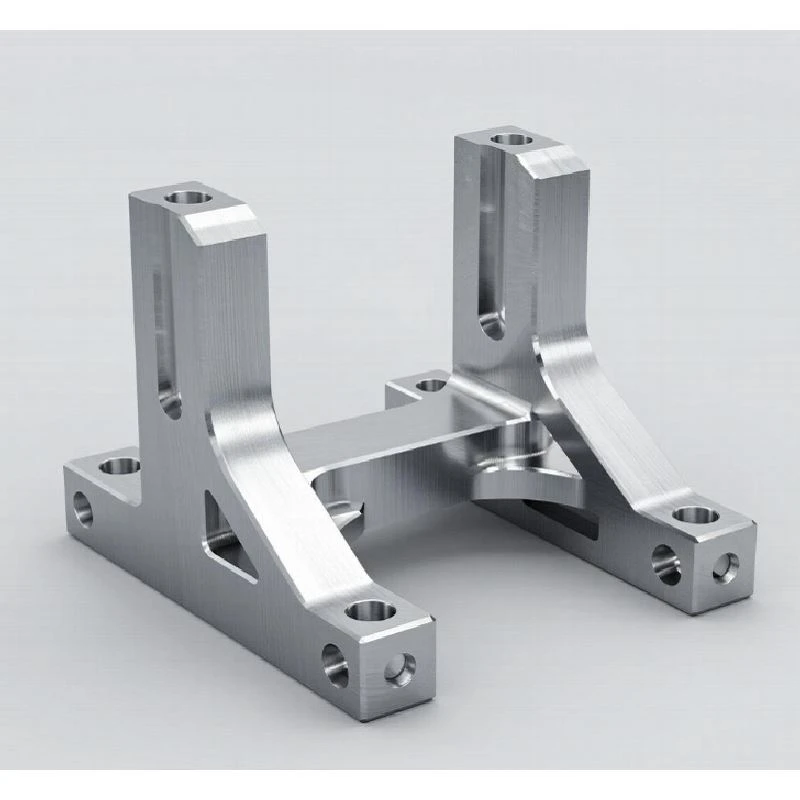
High Precision CNC Milled Structural Brackets
Custom high-precision CNC structural brackets manufactured to your exact 2D/3D CAD specifications. From rapid prototypes in 3–5 days to full-scale production.
Technical Specifications & Capabilities
|
Feature / Metric |
Capability / Standard |
|
Machining Processes |
3-Axis, 4-Axis, and 5-Axis CNC Milling, Drilling, Tapping, Precision Boring |
|
Standard Tolerance |
ISO 2768-m / ISO 2768-f |
|
Precision Tolerance |
Down to +/- 0.008 mm (+/- 0.0003") for critical features |
|
Surface Flatness |
Up to 0.01 mm for critical mounting faces |
|
Surface Roughness |
Standard Ra 1.6 um (Machined); down to Ra 0.8 um upon request |
|
Lead Time |
Prototypes: 3–5 business days; Production: 2–3 weeks |
|
Quality Control |
First Article Inspection (FAI), CMM Inspection, Material Test Certificates (MTC) |
Material Selection Guide
|
Material Class |
Common Grades |
Key Properties & Ideal Uses |
|
Aluminum |
6061-T6, 7075-T6, 2024 |
Excellent strength-to-weight ratio, high machinability. Ideal for automation, robotics, and aerospace enclosures. |
|
Stainless Steel |
304, 316L, 17-4 PH |
High tensile strength and superior corrosion resistance. Preferred for marine, food processing, and medical equipment. |
|
Carbon Steel |
A36, 1018, 4140 |
Outstanding rigidity and cost-effectiveness for heavy industrial equipment and structural frames. |
|
Copper & Brass |
C11000, C36000 |
High electrical and thermal conductivity. Used for grounding brackets, busbars, and decorative fittings. |
Core Advantages
Direct-from-CAD Accuracy: Hole locations, thread dimensions, and interface geometry are translated directly from your digital design to eliminate alignment errors during final assembly.
Complex Multi-Axis Geometries: Multi-axis CNC machining enables features like pockets, ribs, stepped surfaces, and angled faces in a single setup, maintaining tight datum-to-feature relationships.
Weight Optimization: Material can be selectively removed through pocketing and topology optimization without sacrificing structural load capacities.
Consistent Batch Production: Standardized CNC programming ensures strict repeatability across all orders, from low-volume prototypes to high-volume manufacturing.
Surface Finishing Options
Anodizing (Type II / Type III Hardcoat): Enhanced corrosion protection, wear resistance, and color options for aluminum.
Passivation: Chemical treatment for stainless steel to maximize corrosion resistance.
Powder Coating: Durable exterior protection in custom RAL colors.
Bead / Sand Blasting: Uniform matte surface finish that removes machining tool marks.
Electroless Nickel Plating: Uniform wear resistance and corrosion defense for steel components.
Industry Applications
Industrial Automation: Actuator mounts, sensor supports, and robot arm connectors.
Machinery & Equipment: Structural frame connectors, heavy-duty motor bases, and alignment brackets.
Robotics & UAVs: Lightweight chassis supports, gimbal brackets, and structural ribs.
Electronics & Enclosures: Internal mounting frames, heatsink supports, and PCB chassis brackets.
Automotive: Custom fixture mounts, test rig frames, and bracket assemblies.
Standard Manufacturing Process
DFM & Engineering Review: Free Manufacturability analysis on CAD files to optimize tool paths and reduce unit costs.
Material Sourcing & Verification: Raw stock preparation verified against requested Material Test Certificates.
Multi-Axis CNC Milling: Precision machining of main profiles, pockets, mounting features, and datum faces.
Secondary Operations: Thread tapping, precision reaming, and automated or manual deburring.
Surface Finishing: Application of specified surface coatings or treatments
Final CMM Inspection: Critical dimension checking against 2D drawings prior to packing.
FAQ
Q: What is a CNC milled structural bracket?
A: A CNC milled structural bracket is a machined metal component used to support, connect, align, or reinforce components within a mechanical assembly. CNC milling is suitable when the bracket requires accurate holes, threads, mounting surfaces, pockets, slots, or complex three dimensional geometry.
Q: What materials can be used for CNC structural brackets?
A: Common materials include aluminum, stainless steel, carbon steel, copper, and brass. The appropriate material depends on the required strength, weight, corrosion resistance, conductivity, operating environment, and cost requirements.
Q: Can the bracket be manufactured according to a custom drawing?
A: Yes. Custom structural brackets can be manufactured from customer supplied 2D engineering drawings or 3D CAD models. Material, dimensions, tolerances, threads, surface finish, and inspection requirements should be included when applicable.
Q: What machining features can be added to a structural bracket?
A: Depending on the design, CNC machining can produce mounting holes, threaded holes, counterbores, countersinks, slots, pockets, bosses, ribs, stepped surfaces, angled faces, chamfers, and custom external profiles.
Q: How is the dimensional accuracy of the bracket controlled?
A: Dimensional accuracy is controlled through the machining process and inspection of drawing defined critical features. Inspection may include hole position, hole spacing, thread dimensions, mounting surface flatness, thickness, slot dimensions, and other functional dimensions.
Q: What surface finishes are available for CNC machined brackets?
A: Depending on the material and application, surface finishes can include anodizing, passivation, powder coating, brushing, polishing, sand blasting, plating, and other specified treatments.
Q: Can CNC structural brackets be produced for prototypes and production quantities?
A: Yes. CNC milling is suitable for prototype development, low volume manufacturing, and production quantities. Prototype parts can be used to verify fit, mounting interfaces, and function before production quantities are finalized.
Q: What information is required for a CNC structural bracket quotation?
A: A 2D engineering drawing or 3D CAD file is the most useful starting point. Material, quantity, tolerances, surface finish, critical features, and inspection requirements should also be provided when applicable.
Hot Tags: high precision cnc milled structural bracket, China high precision cnc milled structural bracket manufacturers, suppliers, factory, Stainless CNC Turning Ring


