



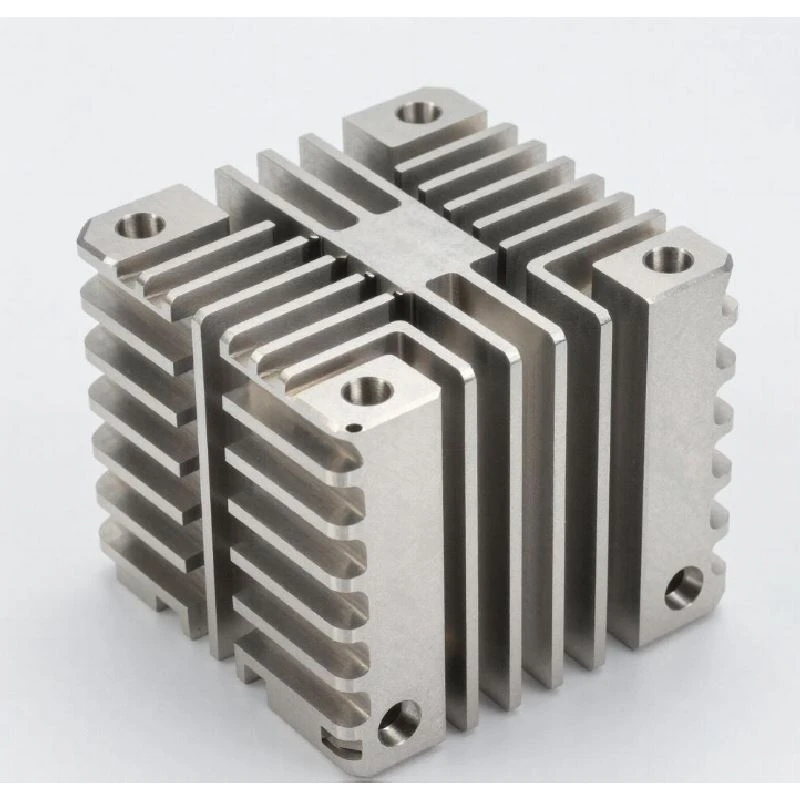
Custom CNC Milled Heatsinks for Electronics
Custom CNC milled heatsinks provide high-precision thermal management and dedicated mechanical mounting for specialized electronic assemblies. Unlike standard extruded heatsinks with fixed profiles, CNC machining allows bases, cooling fins, clearance pockets, and mounting features to be tailored precisely to your PCB layout and enclosure constraints.
Custom Machining & Design Capabilities
Custom Cooling Fins: Precision-machined fin height, thickness, and spacing optimized for natural or forced-air convection.
Thermal Interface Contact: Flat, stepped, or recessed contact bases engineered to maintain high contact uniformity with heat sources.
Integrated PCB Clearance: Machined pockets, slots, and undercuts designed around adjacent components, connectors, and cabling.
Fastening Features: Threaded holes, counterbores, countersinks, and alignment slots for direct assembly without extra brackets.
Multi-Axis Machining: 3-axis, 4-axis, and 5-axis milling capabilities for multi-sided geometric features and complex outer profiles.
Engineering Parameters & Technical Specifications
|
Parameter |
Options & Specifications |
|
Material Options |
Aluminum (6061-T6, 6063-T5, 7075), Pure Copper (C11000, C10200), Copper-Aluminum Hybrids |
|
Machining Tolerances |
Standard +/- 0.05 mm (Up to +/- 0.01 mm for critical dimensions upon request) |
|
Base Surface Flatness |
Down to 0.01 mm / 100 mm (optimized for thermal paste / TIM contact) |
|
Surface Roughness |
Ra 0.8 um to Ra 3.2 um (Machined surface) |
|
Surface Treatments |
Anodizing (Type II / Type III Hardcoat, Clear/Black), Sandblasting, Chromate Conversion, Electroless Nickel Plating |
|
Quality Compliance |
ISO 9001:2015 certified, RoHS & REACH compliant |
Design for Manufacturing (DFM) Review
Evaluating deep-slotting depth vs. cutter stability to avoid fin distortion.
Optimizing internal corner radii to reduce tool wear and machining time.
Defining specific tolerances ($Ra$ values) only on thermal contact zones to control manufacturing costs.
Verifying thread depths, clearance holes, and edge margins.
Quality Assurance & Inspection Evidence
First Article Inspection (FAI)
Dimensional verification before mass production.
CMM Measurement Reports
Full inspection data for critical hole locations and base flatness.
Material Traceability
Mill Test Certificates (MTC) available upon request.
Coating Verification
Anodizing thickness and surface roughness reports.
Production Capabilities & Order Information
|
Service Metric |
Capability |
|
Minimum Order Quantity (MOQ) |
1 Piece (Rapid prototyping & R&D supported) |
|
Sample Lead Time |
3 - 7 business days |
|
Batch Lead Time |
10 - 18 business days |
|
Quote Response Time |
Within 24 hours |
FAQ
Q: What materials are available for CNC machined heatsinks?
A: Aluminum and copper are common choices for CNC machined heatsinks. Aluminum is often selected when low weight, machinability and a balance between thermal performance and cost are important. Copper can be considered when higher thermal conductivity is required.
Q: Can the heatsink be manufactured from my 3D CAD file?
A: Yes. A 3D CAD model can be used for manufacturing review and CNC programming. A 2D engineering drawing is recommended when specific tolerances, flatness, surface finish or inspection requirements need to be controlled.
Q: Can mounting holes and threads be machined directly into the heatsink?
A: Yes. CNC machining can produce through holes, tapped holes, counterbores, countersinks and other mounting features according to the approved drawing.
Q: Can the heatsink be customized for a specific PCB?
A: Yes. The heatsink can be designed around the PCB layout, component dimensions, mounting pattern and available clearance. This is one of the main advantages of using a custom machined heatsink.
Q: Is CNC machining suitable for heatsink prototypes?
A: Yes. CNC machining is suitable for prototypes and small production batches because the heatsink can be produced directly from the CAD design without requiring a dedicated extrusion die.
Q: Can CNC machined heatsinks be anodized?
A: Yes. Aluminum heatsinks can be anodized and can also receive other specified surface treatments such as sandblasting, brushing or polishing. Critical thermal contact surfaces should be identified before finishing.
Q: What information is needed for a heatsink quotation?
A: A 2D drawing or 3D CAD file is the best starting point. Material, quantity, surface treatment and critical tolerances should also be provided. Heat load and airflow information are useful for applications where thermal performance is a critical design requirement.
Q: Can CNC machined heatsinks be used for production quantities?
A: Yes. CNC machining can be used for prototypes, small batches and production quantities. For larger volumes, the manufacturing method should be evaluated based on part geometry, cycle time, material usage and target unit cost.
Hot Tags: custom cnc milling heatsink for electronics, China custom cnc milling heatsink for electronics manufacturers, suppliers, factory, Stainless CNC Turning Ring


