



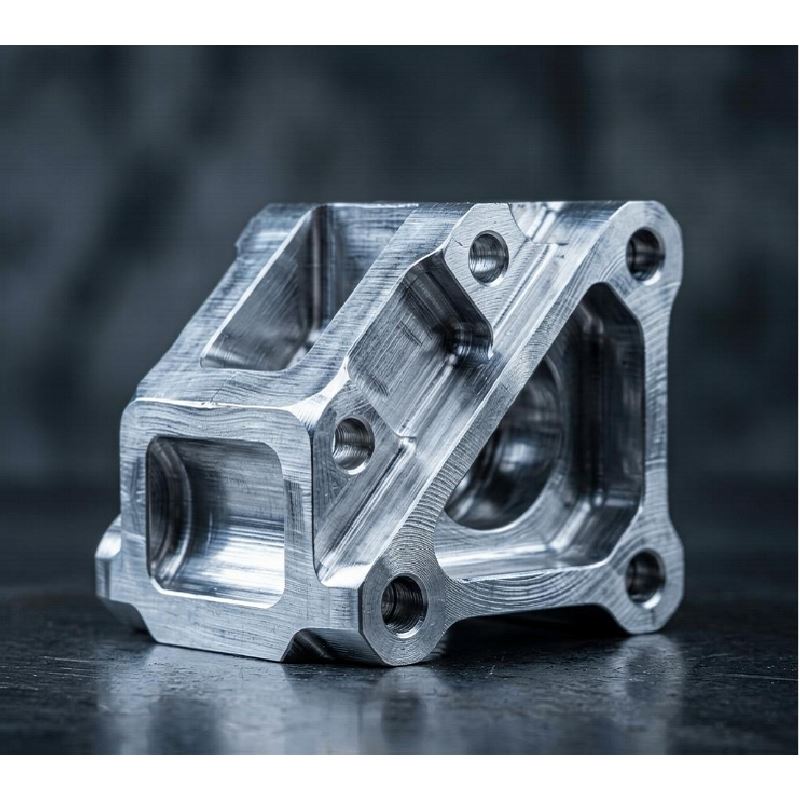
High-Precision 5-Axis CNC Machined Aerospace Parts
Aerospace components frequently combine complex curved surfaces, angled features, deep pockets, thin walls, stiffening ribs, and closely positioned mounting interfaces. Machining these complex geometries using traditional 3-axis processes often requires multiple setups, increasing both cycle times and the risk of dimensional variation.
Technical Capabilities & Manufacturing Specifications
|
Parameter |
Capability / Standard |
|
Machining Process |
5-Axis Simultaneous & Indexing CNC Machining |
|
Standard Machining Tolerance |
Up to +/- 0.005 mm (+/- 0.0002 in) |
|
Surface Roughness (As-Machined) |
Ra 0.8 um to Ra 3.2 um (125 uin) |
|
Quality Management Standards |
ISO 9001:2015 / AS9100D Compliant Workflow |
|
Supported File Formats |
STEP, IGES, X_T, DWG, PDF |
|
Production Stages Supported |
Prototype, First Article (FAI), Low-Volume, Repeat Production |
Key Advantages of 5-Axis Aerospace Machining
Reduced Setups: Reaches multiple faces in a single clamping, minimizing setup-induced positional error.
Enhanced Feature Alignment: Maintains tighter true position, parallelism, and perpendicularity across complex faces.
Optimized Tool Accessibility: Efficiently reaches compound angles, deep pockets, and contoured surfaces with shorter, more rigid tooling.
Weight-Reduction Support: Facilitates the machining of thin walls and intricate rib networks without excessive tool chatter or thermal deformation.
Aerospace CNC Machining Materials
|
Material Grade |
Key Properties |
Typical Aerospace Applications |
|
Aluminum 6061-T6 / 7075-T6 |
Excellent strength-to-weight ratio, low density, high machinability |
Structural brackets, avionics housings, mounting plates, UAV structural frames |
|
Titanium Ti-6Al-4V (Grade 5) |
Superior strength-to-weight performance, high corrosion & thermal resistance |
Actuator components, high-stress structural mounts, load-bearing mechanical joints |
|
Stainless Steel (17-4PH, 316L) |
High mechanical strength, superior wear and corrosion resistance |
Environmental control system parts, high-wear fasteners, specialized fittings |
Quality Assurance & Documentation Package
In aerospace manufacturing, complete documentation is as critical as the physical part. We deliver fully traceable inspection packages tailored to your procurement requirements:
First Article Inspection Report (AS9102 FAIR)
CMM Full-Dimensional Inspection Reports
Certificate of Conformance (CoC)
Raw Material Mill Test Certificates (MTR)
Secondary Surface Treatment / Heat Treat Certificates
Secondary Processes & Surface Finishing
Dimensions are controlled both before and after surface treatments. We accommodate precise thickness allowances for secondary operations:
Applications Served
Aircraft Structural Components: Complex brackets, ribs, structural supports, and lightweight mounting plates.
Avionics & Sensor Housings: Multi-sided enclosures requiring precise hole patterns and sealed interface profiles.
Actuation & Mechanical Systems: High-precision linkages, housings, and clevises.
UAV & Unmanned Systems: Ultra-lightweight structural frames and payload mounts.
FAQ
Q: What aerospace parts are suitable for 5-axis CNC machining?
A: 5-axis CNC machining is suitable for aerospace components containing multiple machined faces, compound angles, curved surfaces, deep pockets, angled holes, ribs, and complex contours.
Q: What is the main advantage of 5-axis machining for aerospace parts?
A: The main advantage is improved access to complex features with fewer repositioning operations when the part geometry is suitable. This can simplify machining and help maintain relationships between related features.
Q: What materials can be machined for aerospace applications?
A: Common materials include aluminum alloys such as 6061 and 7075, titanium alloys such as Ti-6Al-4V, and selected stainless steels. The exact material grade and condition should follow the engineering drawing or purchasing specification.
Q: Can you manufacture parts with GD&T requirements?
A: Aerospace components can be manufactured according to drawing-defined GD&T requirements. Position, profile, flatness, perpendicularity, parallelism, and other geometric requirements can be incorporated into the machining and inspection process.
Q: Can CMM inspection be used for aerospace components?
A: Yes. CMM inspection can be used for suitable components to verify dimensional and geometric requirements, especially where complex surfaces, feature relationships, or positional tolerances are difficult to verify using conventional measuring equipment.
Q: Can material certificates and inspection documentation be supplied?
A: Material certificates, dimensional inspection reports, CMM reports, Certificates of Conformance, and other project-specific documentation can be arranged when required.
Q: Do you support prototypes and low-volume aerospace parts?
A: Prototype, first-article, and low-volume requirements can be evaluated according to part geometry, material, quantity, inspection requirements, and customer specifications.
Q: What information should be included in an aerospace CNC machining RFQ?
A: The most useful information includes the 2D engineering drawing, matching 3D CAD model, material specification, quantity, tolerances, GD&T requirements, surface finish, surface treatment, inspection requirements, certification requirements, and current drawing revision.
Hot Tags: high precision 5-axis cnc machined aerospace part, China high precision 5-axis cnc machined aerospace part manufacturers, suppliers, factory, Stainless CNC Turning Ring


