



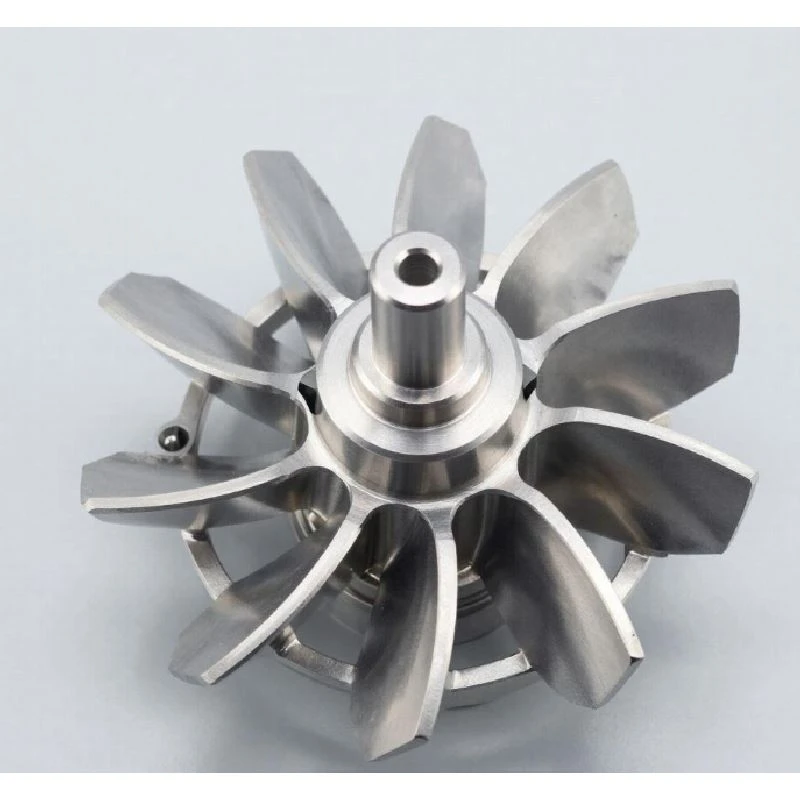
Custom 5-Axis CNC Machined Aluminum Impellers
We manufacture custom 5-axis CNC machined aluminum impellers for complex blade profiles, curved hub transitions, and high-speed precision rotating assemblies. Whether you require a prototype for R&D testing, low-volume custom batches, or repeat OEM production, our manufacturing process ensures strict adherence to your 3D CAD models and 2D engineering drawings.
Technical Specifications & Capabilities
|
Parameter / Feature |
Manufacturing Specification / Standard |
|
Machining Process |
Continuous 5-Axis CNC Milling |
|
Common Aluminum Alloys |
6061-T6, 7075-T6, 2024-T3, 6063 |
|
Machining Accuracy |
Up to ±0.005 mm (0.0002 in) |
|
Impeller Diameter Range |
Ø 30 mm to Ø 600 mm (Custom sizes on request) |
|
Surface Roughness |
As Machined (Ra 1.6 - 3.2 Ra), Polished (Ra 0.4 - 0.8 Ra) |
|
Dynamic Balancing |
ISO 1940 Grade G2.5 / G6.3 (Optional) |
|
Surface Treatments |
Clear/Color Anodizing, Hard Anodizing, Bead Blasting, Chemical Film |
|
Inspection Reports |
CMM Dimensional Report, FAIR, Material Test Report (MTR), CoC |
|
Data Security |
Strict NDA execution prior to file submission |
Why Use Continuous 5-Axis CNC Machining?
Precision tool engagement between tightly spaced, twisted blades.
Elimination of step marks and stress concentration points along fillet radii.
High concentricity and minimal runout by machining critical features in unified clampings.
Accurate representation of complex fluid and aerodynamic designs directly from your CAD model.
Critical Manufacturing Controls
Blade Geometry: Blade profiles and wall thicknesses are machined strictly to CAD specifications to ensure predictable fluid or airflow performance.
Bore & Shaft Interface: Central bores, keyways, and mounting threads are precision-machined to maintain correct fitment and alignment.
Concentricity & Runout: Radial and axial runout controls are integrated into the machining process to optimize the component for rotational stability.
Rotational Requirements: For high-RPM applications (compressors, turbochargers, blowers), manufacturing processes are tailored to meet specified balance grades and runout limits.
Material Selection Guide
|
Aluminum Alloy |
Key Characteristics |
Common Applications |
|
Aluminum 6061-T6 |
Excellent machinability, balanced strength, superior corrosion resistance. |
General-purpose industrial impellers, prototype testing. |
|
Aluminum 7075-T6 |
High yield strength, excellent fatigue resistance, high strength-to-weight ratio. |
High-RPM impellers, turbomachinery, aerospace components. |
|
Aluminum 2024-T3 |
High fatigue strength and toughness. |
High-stress rotating parts requiring structural endurance. |
Quality Inspection & Documentation
To verify complex geometries against engineering requirements, parts are inspected using calibrated instruments and 3D Coordinate Measuring Machines (CMM).
Inspection Records Available:
- CMM Measurement Report (3D surface profile and critical feature mapping)
- Dimensional Inspection Report (Bore diameter, thread, and thickness checks)
- First Article Inspection Report (FAIR)
- Material Test Report (MTR)
- Certificate of Conformance (CoC)
Target Applications
Compressors & Blowers: Custom impellers designed for air-handling and gas compression systems.
Pumps & Fluid Handling: Machined impellers tailored for specialized liquid movement and chemical compatibility.
Turbomachinery: Lightweight, high-speed rotating components built for demanding thermal and mechanical conditions.
R&D & Prototypes: Direct-from-CAD manufacturing to test and validate aerodynamic revisions prior to mass tooling.
FAQ
Q: Why is 5-axis CNC machining suitable for complex aluminum impellers?
A: Impeller blades often contain curved surfaces and narrow passages that are difficult to reach from a fixed tool direction. 5-axis machining allows the cutting tool to change orientation while following these surfaces.
Q: What aluminum alloys can be used for CNC impellers?
A: Common options include 6061, 6063, 7075 and 2024 aluminum. The correct alloy depends on the required mechanical properties, weight, operating environment and finishing requirements.
Q: Can an impeller be manufactured directly from a STEP file?
A: Yes. A 3D CAD model such as STEP provides the geometry needed to program complex blade surfaces. A 2D drawing should also be supplied for tolerances, material, surface finish and inspection requirements.
Q: Can you manufacture prototype and low-volume impellers?
A: CNC machining is suitable for prototype and low-volume production because the component can be machined directly from the engineering design without dedicated casting tooling.
Q: What impeller features normally require inspection?
A: Depending on the application, inspection may include blade profile, blade thickness, hub diameter, bore diameter, mounting features, concentricity, runout and surface roughness.
Q: Can aluminum impellers be anodized?
A: Yes. Anodizing can be used when the application requires a specific appearance or additional surface protection. Critical bores, threads and mating surfaces may require masking.
Q: Do high-speed impellers require balancing?
A: They may. Balance requirements depend on the operating speed and equipment design. If balancing is required, the applicable balance specification should be included with the engineering documentation.
Q: What information should be provided for an impeller quotation?
A: Provide the 3D CAD model, 2D drawing, material, quantity, critical tolerances, surface finish, surface treatment, inspection requirements and required documentation.
Hot Tags: complex 5-axis cnc aluminum impeller component, China complex 5-axis cnc aluminum impeller component manufacturers, suppliers, factory, Stainless CNC Turning Ring


