



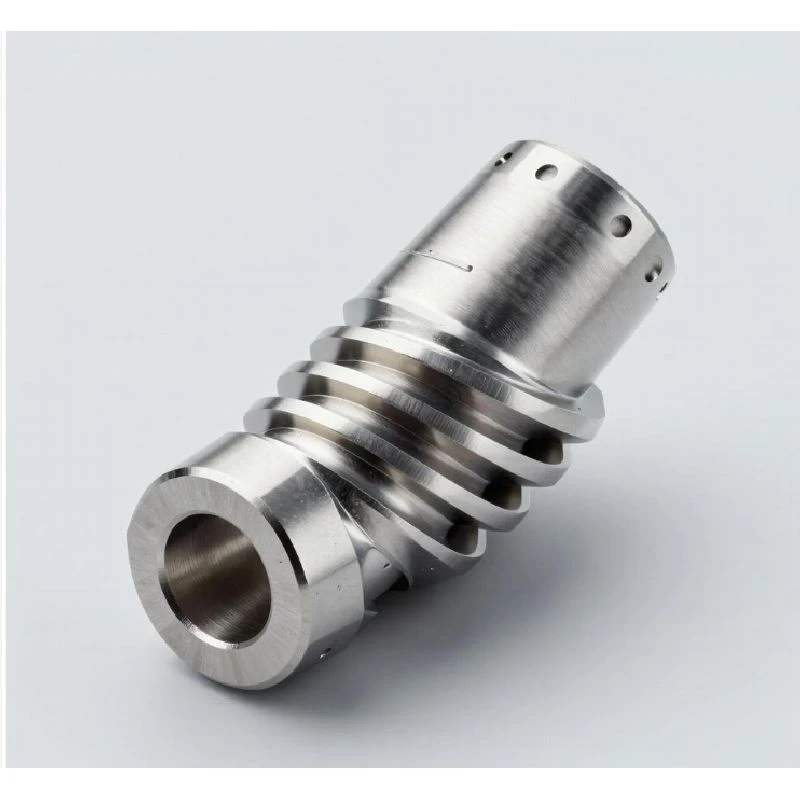
Custom 5-Axis Machined Titanium Medical Implant Parts
We specialize in custom 5-axis CNC machined titanium components for orthopedic, spinal, dental, and bone fixation implant applications. We deliver fully traceable, high-precision parts engineered to meet strict mechanical, dimensional, and biological compatibility requirements.
Technical Specifications & Capabilities
|
Feature / Metric |
Capabilities & Standards |
|
Machining Capabilities |
Continuous 5-Axis CNC Milling, Precision Turning, Threading |
|
Machining Tolerances |
Down to +/- 0.005 mm (depending on feature geometry) |
|
Surface Roughness |
Ra 0.4 um to Ra 3.2 um (as specified by drawing) |
|
Quality Management |
ISO 13485 (Medical Devices), ISO 9001 |
|
Inspection Methods |
CMM Dimensional Inspection, Optical Measurement, Thread Gauging |
|
Accepted File Formats |
STEP (.stp), IGES (.igs), Parasolid (.x_t), PDF 2D Drawings |
|
Production Scope |
Functional Prototypes, Low-Volume Batches, High-Volume Production |
Medical-Grade Titanium Materials
|
Material Grade |
Standard Specification |
Key Characteristics |
Typical Applications |
|
Ti-6Al-4V (Grade 5) |
ASTM F1472 / ISO 5832-3 |
High strength-to-weight ratio, excellent fatigue resistance |
Structural orthopedic plates, spinal connectors |
|
Ti-6Al-4V ELI (Grade 23) |
ASTM F136 / ISO 5832-3 |
Extra Low Interstitial, superior damage tolerance & toughness |
Load-bearing permanent implants, joint components |
|
Commercially Pure Ti (Grades 1-4) |
ASTM F67 / ISO 5832-2 |
High corrosion resistance, excellent biocompatibility |
Dental implants, maxillofacial fixation plates |
Advanced 5-Axis Machining & Process Control
Datum & Feature Integrity: Single-setup machining reduces repositioning errors, ensuring precise alignment between critical features and established datums.
Optimized Titanium Processing: Controlled cutting speeds, high-pressure cooling, and specialized tooling manage thermal distribution and prevent work hardening.
Thin-Section Stability: Progressive toolpaths and custom workholding minimize mechanical deflection and residual stress on delicate profiles.
Precision Edge Control: Automated and manual deburring ensures smooth transitions on complex threads, counterbores, and cross-hole intersections.
Primary Implant Applications
Orthopedic Implants
Joint replacements, structural bone plates, and custom anatomical implants.
01
Spinal Implants
Cervical and lumbar cages, pedicle screws, and complex connecting rods.
02
Dental Implants
Custom abutments, mini-implants, and high-precision prosthetic interfaces.
03
Bone Fixation
Reconstruction plates, trauma pins, and multi-angle fixation devices.
04
Prototypes & Development
Rapid DFM validation and pre-production functional prototypes.
05
Quality Assurance & Complete Traceability
Inspection Methods
CMM Verification: 3D coordinate measurement for complex anatomical curves and GD&T features.
Optical & Thread Inspection: High-magnification verification for micro-features and thread profiles.
Surface Roughness Testing: Profilometer analysis verified against drawing specifications.
Production Documentation Package
- Mill Test Certificates (MTR / Mill Certs)
- Certificate of Conformance (CoC)
- Dimensional & CMM Inspection Reports
- First Article Inspection (FAI) Reports
- Passivation, Anodizing, and Surface Treatment Records
FAQ
Q: What titanium grades are commonly used for medical implant components?
A: Ti-6Al-4V and Ti-6Al-4V ELI are common titanium choices for medical components. The required grade should always follow the customer's approved material specification and engineering requirements.
Q: Why is 5-axis CNC machining suitable for titanium implant parts?
A: 5-axis machining allows the cutting tool to approach complex surfaces and features from different orientations. This can be useful for anatomical contours, angled holes, deep features, and multi-surface components.
Q: Can custom orthopedic and spinal components be manufactured from CAD files?
A: Yes. Custom components can be evaluated and machined from customer-supplied 3D CAD models and engineering drawings after reviewing the geometry, material, tolerances, workholding, and inspection requirements.
Q: How are critical dimensions inspected?
A: The inspection method depends on the feature and required tolerance. CMM, optical measurement, calibrated gauges, thread inspection, and other suitable metrology methods may be used.
Q: Can titanium material traceability be provided?
A: Material certificates and heat or lot information can be provided when included in the agreed project requirements. Documentation requirements should be confirmed before production.
Q: What information is needed for a titanium implant part quotation?
A: A 3D CAD model, 2D drawing, material grade, quantity, tolerance requirements, surface finish, inspection requirements, and documentation requirements provide a useful basis for quotation.
Q: Can titanium medical components be deburred and surface finished?
A: Yes. Deburring, edge control, polishing, passivation, anodizing, and other specified treatments may be considered depending on the titanium grade, part geometry, dimensional requirements, and customer's specification.
Q: Can prototype and repeat production quantities be supported?
A: Custom CNC machining can be used for prototype and repeat production. The appropriate process depends on component geometry, quantity, material, inspection requirements, finishing requirements, and production documentation.
Hot Tags: custom 5-axis machined titanium medical implant part, China custom 5-axis machined titanium medical implant part manufacturers, suppliers, factory, Stainless CNC Turning Ring


