



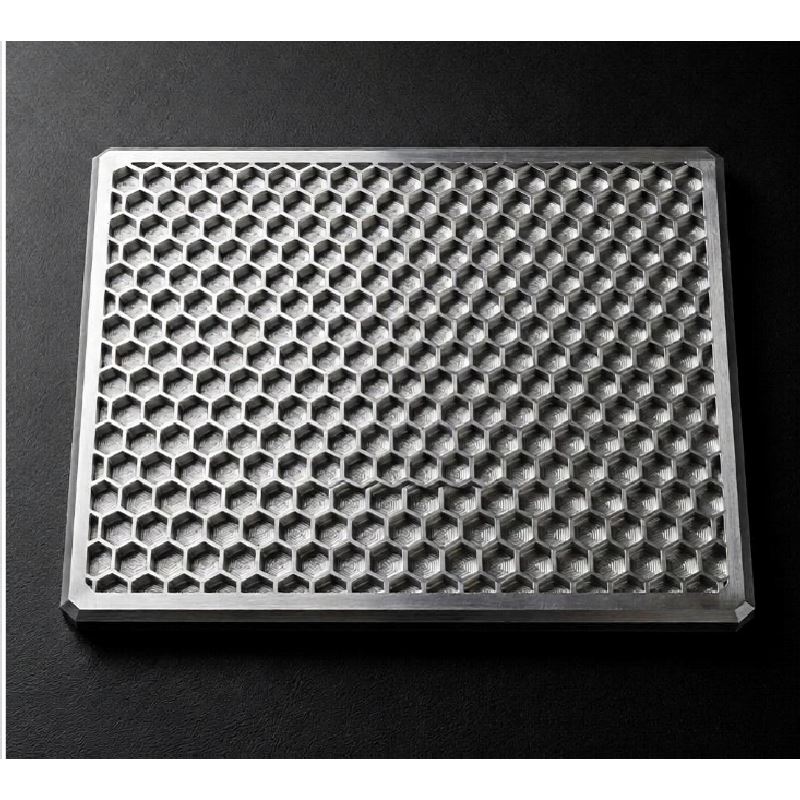
Precision Machined CNC Milling Cover Plate
Custom CNC milled cover plates manufactured from customer drawings and CAD models for machinery, automation equipment, electronics, enclosures, fixtures, and precision mechanical assemblies.
Technical Specifications & Machining Capabilities
|
Feature |
Standard Capability |
Precision / Optional Capability |
|
Machining Tolerance |
+/- 0.05 mm (+/- 0.002 in) |
Up to +/- 0.01 mm (+/- 0.0004 in) |
|
Surface Roughness (Ra) |
Ra 1.6 - Ra 3.2 um (63 - 125 uin) |
Up to Ra 0.8 um (32 uin) or finer |
|
Plate Thickness |
1.0 mm - 100.0 mm+ |
Custom thickness upon review |
|
Maximum Dimensions |
Up to 1000 mm x 600 mm x 300 mm |
Larger sizes evaluated upon request |
|
Geometrical Control |
Flatness, Parallelism, Perpendicularity |
Controlled per 2D GD&T requirements |
|
Quality System |
Manufactured under ISO 9001:2015 standards |
Full CMM inspection & MTR available |
Material Selection Guide
|
Material Category |
Common Grades & Alloys |
Typical Applications & Characteristics |
|
Aluminum |
AL 6061-T6, AL 7075-T6, AL 5052, AL 6082 |
Lightweight, excellent machinability, ideal for automation and electronics housings. |
|
Stainless Steel |
SS 304, SS 316L, 17-4 PH, SS 430 |
High strength, superior corrosion resistance, suitable for harsh or marine environments. |
|
Carbon & Alloy Steel |
Mild Steel (1018 / A36), 4140, 4340 |
High rigidity and wear resistance, often used for heavy industrial equipment. |
|
Brass & Copper |
Brass C36000, Copper C11000 |
Excellent thermal and electrical conductivity, low friction properties. |
|
Engineering Plastics |
POM (Delrin / Acetal), PEEK, Nylon (PA6/PA66), PTFE, ABS |
Non-conductive, lightweight, chemical resistant, ideal for insulation or light-duty covers. |
Precision CNC Milling Features
Hole Features
Through holes, blind holes, tapped (threaded) holes, counterbored holes for socket head cap screws, and countersunk holes.
Internal Geometry
Milled pockets, clearance recesses, slots, steps, and mounting bosses.
Complex Profiles
Custom outer contours, edge chamfers, radii, and multi-axis machined faces.
Assembly Problems Milled Cover Plates Solve
Hole Alignment Issues: Precision CNC hole pattern placement eliminates installation binding on existing housings.
Mating Surface Gaps: Controlled flatness and surface roughness eliminate visible gaps, fluid leaks, and uneven strain on fasteners.
Fastener Clearance: Counterbores and countersinks allow bolt heads to sit flush or below the outer surface.
Internal Component Interference: Recessed pockets create precise clearance for underlying components without increasing overall plate thickness.
Surface Finishing & Protection Options
Anodizing (Aluminum): Type II (Clear, Black, Color) and Type III Hardcoat.
Powder Coating & Painting: High-durability aesthetic coatings.
Bead Blasting & Brushing: Creates a clean, matte, or textured surface.
Plating & Oxide: Electroless Nickel, Zinc Plating, or Black Oxide for steel and copper.
As-Machined Finish: Deburred edges with a smooth machined surface.
Quality Assurance & Inspection
Dimensional Verification: Length, width, thickness, hole-to-hole spacing, counterbore depth, and thread pitch/depth.
Geometric & Surface Testing: Flatness, parallelism, and surface roughness (Ra) measurement.
Inspection Equipment: Calipers, micrometers, height gauges, thread plug/ring gauges, optical comparators, and Coordinate Measuring Machines (CMM).
Documentation: Material Test Reports (MTR) and CMM Dimensional Inspection Reports are provided upon request.
DFM (Design for Manufacturability) & Cost Factors
Internal Radii
Avoid excessively sharp inside corners; use tool-friendly corner radii.
Pocket Depths
Keep pocket depth-to-width ratios balanced to reduce tool deflection.
Tolerances
Apply tight tolerances (+/- 0.01 mm) only to critical functional features, while using standard tolerances (+/- 0.05 mm) elsewhere.
Typical Applications
- Industrial machinery & automation equipment
- Robotics & end-effectors
- Electronics enclosures & junction boxes
- Test, measurement, and medical instruments
- Pump, drive, and fluid-handling assemblies
- Precision jigs and manufacturing fixtures
FAQ
Q: Can you manufacture CNC milling cover plates from our drawings?
A: Yes. Custom cover plates can be manufactured according to customer-supplied 2D drawings and 3D CAD models. Dimensions, hole patterns, threads, pockets, surface requirements and other specified features can be reviewed according to the drawing.
Q: What materials can be used for CNC machined cover plates?
A: Common materials include aluminum, stainless steel, carbon steel, alloy steel, brass, copper and selected engineering plastics. The final material grade should be specified in the engineering drawing or purchasing specification.
Q: Can the cover plate include threaded holes and counterbores?
A: Yes. CNC milling can produce tapped holes, counterbores, countersinks, slots and pockets. Thread size, depth and location should be defined on the engineering drawing.
Q: How is flatness controlled on a CNC milled cover plate?
A: Flatness depends on material, thickness, part size, geometry, machining sequence and workholding. When flatness affects assembly, the required flatness tolerance should be included on the drawing so that the machining and inspection approach can be planned accordingly.
Q: What tolerance can be achieved on a CNC milled cover plate?
A: There is no universal tolerance for every feature. Achievable accuracy depends on material, geometry, part size, thickness, machining process and specific feature requirements.
Q: Can CNC milled cover plates receive surface finishing?
A: Yes. Depending on the material and application, finishing options may include anodizing, powder coating, bead blasting, brushing, polishing, plating or black oxide. Critical mating surfaces may require masking or controlled finishing.
Q: Can inspection reports be provided?
A: Inspection documentation can be provided according to project requirements. Typical inspection points include hole position, thickness, flatness, thread dimensions, pocket dimensions and other critical characteristics identified on the drawing.
Q: Can you produce prototypes as well as repeat production quantities?
A: Yes. CNC milling can be used for functional prototypes, small batches and repeat production.
Hot Tags: precision machined cnc milling cover plate, China precision machined cnc milling cover plate manufacturers, suppliers, factory, Stainless CNC Turning Ring


