


Complex Precision 5-Axis CNC Robotics Housing
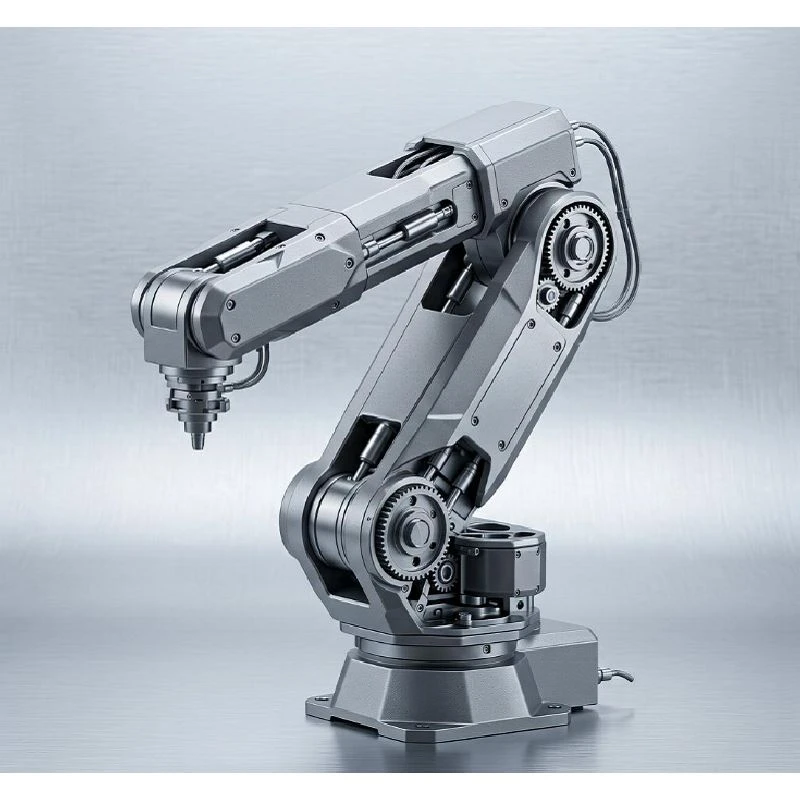
A robotics housing serves as the structural backbone of an automation system. It supports critical mechanical interfaces including bearing seats, motor mounts, gearboxes, shafts, encoders, and sensors. The positional accuracy of these features directly impacts assembly alignment and operational performance.
Technical Specifications & Capabilities
|
Parameter |
Specification / Detail |
|
Machining Technology |
5-Axis Simultaneous CNC Milling & Turning |
|
Supported Materials |
Aluminum (6061-T6, 7075-T6), Stainless Steel (304, 316, 17-4 PH), Titanium (Grade 5 / Ti-6Al-4V) |
|
Critical Features |
Precision bearing bores, motor/reducer mounting faces, angled/cross holes, deep internal pockets, thin-wall ribs |
|
Surface Treatments |
Type II Anodizing, Type III Hardcoat Anodizing, Passivation, Bead Blasting, Brushing |
|
Inspection Equipment |
Coordinate Measuring Machine (CMM), Surface Roughness Testers, Thread Gauges, Bore Gauges |
|
Quality Deliverables |
Material Certifications, CMM Inspection Reports, First Article Inspection (FAI) Reports |
|
Production Volume |
Prototypes, Low-Volume Production, Repeat Production Runs |
Why Choose 5-Axis CNC Machining?
Setup Stack-up Errors: Reduces major fixture changes to maintain high positional accuracy.
Complex Angular Features: Machines off-axis holes and compound angles directly without special angled fixtures.
Assembly Misalignment: Ensures strict perpendicularity and concentricity between motor mounts, reducers, and output shafts.
Weight-Critical Designs: Enables efficient pocketing and thin-wall machining without structural distortion.
Prototyping & Low-Volume Flexibility: Direct machining from CAD data removes the need for expensive casting or molding tooling.
Manufacturing Process
CAD & Drawing Review: Verification of 3D CAD models, 2D drawings, GD&T requirements, datums, and surface finishes.
DFM Analysis: Evaluation of tool reach, deep cavity radii, thin-wall stability, and fixture access prior to production.
Workholding & Datum Planning: Fixturing strategies built directly around primary, secondary, and tertiary functional datums.
Rough & Finish Machining: Bulk material removal followed by 5-axis precision finishing of bores, faces, and contours.
Deburring & Quality Control: Removal of edge burrs to prevent internal particle contamination in sensitive robotic assemblies.
Surface Finishing & Masking: Precision masking on critical bearing bores and threads prior to anodizing or coating.
Final CMM Inspection: Comprehensive geometric and dimensional verification relative to customer drawing datums.
RFQ Checklist
To receive an accurate quotation, please provide the following details:
|
3D File |
STEP or STP format |
|
2D Drawing |
PDF format with explicit GD&T, critical tolerances, and thread details |
|
Material |
Grade and temper (e.g., Aluminum 7075-T6) |
|
Quantity |
Initial prototype count and estimated annual volume |
|
Post-Processing |
Specified surface treatment and required masking areas |
FAQ
Q: Why is 5-axis CNC machining preferred for robotics housings?
A: 5-axis machining allows cutting tools to approach complex geometry from any angle in a single setup, minimizing repositioning errors and accurately maintaining geometric relationships between interconnected features.
Q: How are precision bearing bore tolerances maintained after surface treatment?
A: Coating thickness is factored into the manufacturing plan. Critical mating surfaces, threads, and precision bores are either masked during treatment or post-processed to guarantee final drawing tolerances.
Q: How are complex geometric relationships (GD&T) verified?
A: Advanced Coordinate Measuring Machines (CMM) are used to measure multi-axis feature positions, concentricity, perpendicularity, and true position relative to primary engineering datums.
Hot Tags: complex precision 5-axis cnc robotics housing, China complex precision 5-axis cnc robotics housing manufacturers, suppliers, factory, Stainless CNC Turning Ring


