



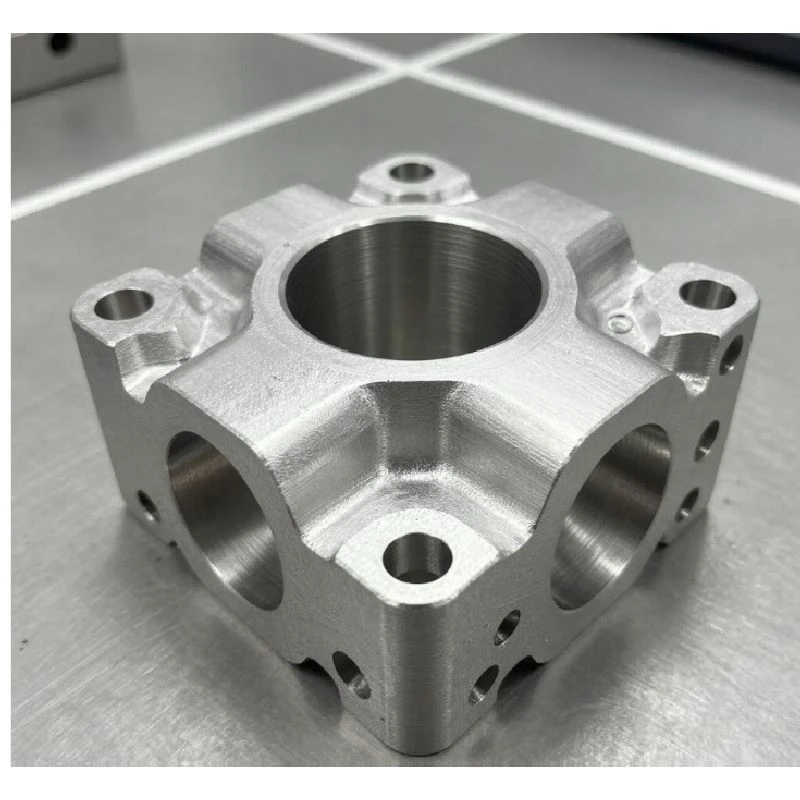
Custom 5-Axis Machined Aluminum Automotive Mold Parts
Custom 5-axis machined aluminum automotive mold parts are engineered for mold inserts, cavities, tooling components, and prototype tooling requiring complex curved surfaces, angled features, or multi-directional machining.
5-Axis CNC Machining for Complex Automotive Mold Geometry
Optimal Tool Access: Maintains ideal cutting angles on complex curved and angled surfaces.
Single-Setup Efficiency: Reaches multiple faces in a single operation, drastically reducing setup errors.
Enhanced Feature Alignment: Improves geometric relationships and tight tolerances between relative surfaces.
Deep Cavity Machining: Allows shorter, more rigid cutting tools to reach deep or angled areas, minimizing chatter.
Superior Surface Quality: Eliminates unnecessary manual polishing through precise, continuous toolpath control.
Aluminum Alloys for Automotive Tooling
Excellent general machinability, structural stability, and corrosion resistance.
High-strength alloy widely used in European automotive tooling standards.
High-yield strength alloy approaching steel hardness, ideal for high-stress mold inserts and extended prototype runs.
Machined to exact project requirements upon request.
Technical Specifications
|
Parameter |
Capability / Specification |
|
Manufacturing Process |
5-Axis Continuous & Positional CNC Milling |
|
Part Types |
Automotive Mold Inserts, Cavities, Tooling Components, Prototype Molds |
|
Material Options |
Aluminum Alloys (6061-T6, 6082-T6, 7075-T6, or specified equivalent) |
|
Standard Tolerance |
±0.050 mm (±0.002 in) |
|
Precision Tolerance |
Up to ±0.012 mm (±0.0005 in) - Subject to geometry & CMM verification |
|
Surface Roughness |
As-Machined: Ra 1.6 µm Fine Milling: Ra 0.8 µm Polished: Up to SPI-A2 (Ra 0.05 µm) |
|
Secondary Treatments |
Anodizing (Type II/III), Hardcoating, Bead Blasting, Fine Polishing |
|
Quality & Inspection |
CMM Dimensional Reports, First Article Inspection (FAI), Material Certificates |
Automotive Tooling Applications
Automotive Interior Tooling: Prototype tooling and mold inserts for instrument panels, door trim panels, center consoles, decorative trim, and polyurethane foam molding.
Automotive Exterior Tooling: Tooling components for bumper fascias, grilles, exterior body trim, aerodynamic components, and styling validation models.
Modular Mold Inserts & Thermoforming: Custom aluminum inserts designed for modular mold replacement, localized cooling adjustments, or rapid design modifications during testing.
DFM & Quality Assurance Workflow
CAD & Drawing Analysis
Cross-referencing 3D models with 2D drawings for critical datums and tolerances.
DFM Evaluation
Checking cutter accessibility, depth-to-width ratios, corner radii, and wall thickness.
CAM Toolpath Strategy
Programming continuous 5-axis toolpaths optimized for stock removal and surface finish.
Machining & Quality Inspection
Executing roughing and precision finishing followed by full CMM dimensional measurement.
FAQ
Q: What aluminum alloys are best suited for automotive mold parts?
A: 6061-T6 is standard for general prototypes, while 7075-T6 is preferred for high-stress inserts requiring superior wear resistance and high-polish finishes.
Q: Why choose 5-axis CNC machining over 3-axis for mold components?
A: 5-axis machining optimizes cutting angles across curved surfaces, reduces workholding setups, and improves positional accuracy between features located on different faces.
Q: What dimensional tolerances can be achieved?
A: Standard machining tolerance is ±0.050 mm. Critical features can achieve up to ±0.012 mm depending on part geometry, material stability, and thermal controls.
Q: Can aluminum mold inserts be modified after prototype testing?
A: Yes. Aluminum's excellent machinability allows for easy post-test engineering revisions and structural modifications, provided sufficient stock material remains.
Hot Tags: custom 5-axis machined aluminum automotive mold part, China custom 5-axis machined aluminum automotive mold part manufacturers, suppliers, factory, Stainless CNC Turning Ring


